
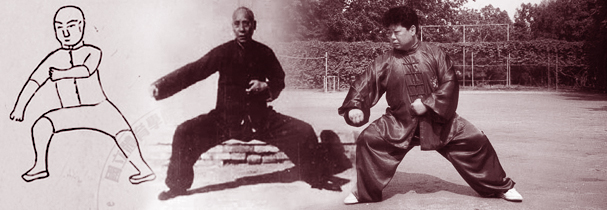
There has been a lot of talk about small, big, new and old frames of Chen Taijiquan. But today I want to take a different perspective on the topic. And that is: we HAVE TO change our frame.
I can sometimes perceive a wrong sense of tradition and obligation towards a certain tradition (also in myself) which leads us to think we shouldn't change anything in what our teacher taught us. While that is true as it doesn't make much sense to change everything you have been shown without understanding any of its depth yet, it is also wrong not to change one's frame at all.
Actually we need to change our frame all the time to become better. Because in the beginning our frame will not be correct anyway. We have many prerequisites in Chen Taijiquan (as in most other martial arts) which are actually intended to initiate just that improvement of our frame. Like "rounding the crotch", "the knees do not move past the toes", "the waist force penetrates downwards", "binding ribs, closing belly", "empty neck and crown of the head force" and so on.
When someone learns external movements the frame will for example be quite big. Like when kids learn, they make big movements, mobilizing joints, stretching a bit and so on. and that can be quite beneficial. Slowly when we build in key aspects a lineage requires the frame will get smaller, trighter, but nonetheless stay expanded. For example, when the "dang jin", the crotch force (a specific term in Chinese martial arts) is being discovered, the activation of the crotch will change the relation of the feet to one another, binding the forces inside so that even the range of movement of the hands will be affected and it will be obvious to serious practitioners how this one force (just like some other key forces) relates to the whole body force (zhengtijin) we want to develop. Opening and closing is paramount to this kind of body work and it will become more and more specific.
So that might be a good thing to consider: we want our training efforts to change our external frame by putting internal concepts into practice. Whether we call that frame old, new, big or small doesn't really matter. That's more a matter of oral and written tradition and these terms have changed all the time anyway. If our frame is devoid of the internal concepts, however, it will be an empty frame, and that is all we really have to worry about.