
CTN Academy / Practice & transmission
Four Decades Alongside Chen Yu
A Firsthand Account of Chen Yu’s Family-Transmitted Gongfu Frame
Chen Yu's wife Siyu recalls four decades alongside Chen Yu: the first encounters, the discipline of daily practice, and the hardships behind a family’s living martial tradition.
Translation by Linda from Chen Taijiquan Nairobi.
By 思雨 Siyu
家传功夫架 jiāchuán gōngfu jià · Five episodes and a continuation

Episode One
Our First Meeting in the Summer of 1985
10.08.2026
Original publication: Chen Yu Taiji · Issue 1222
My connection with Chen Clan Taijiquan goes back to 1976.
A courtyard in Donghuashi
At the time, I lived in a traditional courtyard residence at No. 36 Xia’ertiao, Donghuashi, behind Beijing Railway Station. The courtyard stood above street level, reached by a flight of steps. Four courtyards were arranged at different levels along the slope, and my family lived in the small one furthest in, on the western side.
It was not a large courtyard, yet even after all these years, every plant and tree, every room and building, remains vividly etched in my memory. Six households lived there. My family occupied the southeastern rooms. Teacher Tian Xiuchen lived in the southern rooms, while his son lived in the western rooms. The eastern room of the northern wing was home to Tian Xiuchen’s elder brother and sister-in-law, the parents of the four Tian brothers: Tian Qiutian, Tian Qiukun, Tian Qiuxin, and Tian Qiumao. Tian Qiukun, the second of the four brothers, occupied the central room of the northern wing. Another household lived in the northwestern corner.
A double wooden gate opened into the courtyard. Just inside, an old water pipe stood in the middle, with a square patch of open ground beyond it. It was here, in this small space, that my nine-year-old older brother became Tian Xiuchen’s disciple. Day after day, they practiced Taijiquan and push hands together. At the time, I called Tian Xiuchen 二爷 èr yé—“Second Grandpa.” I would often stand quietly to one side, watching the movements rise and fall. Through this daily exposure, the first seeds of my interest in Chen Clan Taijiquan took root.
A summer visit
The years passed, and before I knew it, the height of summer had arrived in 1985.
One day, my brother and several of his fellow students practiced Taijiquan and push hands in Beihai Park with Teacher Chen Yu, Teacher Yang Wenhu, and a group of other practitioners. After training, they came to our home. It was on that sweltering summer day that I first met Chen Yu.

He was in his early twenties, with a striking head of thick, naturally curly hair. He wore a yellow tank top with a dragon design across the chest and black pants with crisp, neat creases. His clothes were modest, but he was clean and smartly dressed. He had an open, forthright manner, a distinctly masculine bearing, and a powerful presence.
At our first meeting, he said little and was not particularly at ease with small talk. In the summer heat, I brought out a plate piled high with freshly cut watermelon for our guests. Everyone helped themselves except him. He did not eat any. That small gesture has stayed with me ever since.
The memory of a first encounter
The atmosphere in the room was relaxed, and on the spur of the moment I played “Melody of the Four Seasons” (《四季调》 Sìjì Diào) for our guests. The music flowed gently through the room, easing the heat of the summer day and becoming a distinctive part of the memory of that first meeting.
It was only a brief encounter; we did not speak at any length. All I knew was that our visitors practiced Chen Clan Taijiquan. I knew nothing of Chen Yu’s background, nor did I know that his father had died and he was living on his own. Everyone who visited was older than I was. To my younger self, they were all older brothers.
None of us could have imagined that this short summer encounter would mark the beginning of our shared path in Taijiquan. Over the four decades that followed, I remained by his side, witnessing firsthand how the family-transmitted Gongfu Frame of Chen Clan Taijiquan was carried forward and continued to develop.
Related article: Chen Yu Taiji, Issue 981, “A Century of Unbroken Transmission: Passing On the Flame and Its Glory.”
Back to the chapter menuEpisode Two
1986: Meeting Again and Beginning Our Martial Connection
11.08.2026
Original publication: Chen Yu Taiji · Issue 1223
Continued from the previous episode.
Our first meeting in the summer of 1985 was no more than a passing encounter. I was young and inexperienced then. I knew only that our visitors all practiced Chen Clan Taijiquan. I knew nothing of Chen Yu’s life and background, much less of the burdens he had shouldered from a young age or his unwavering commitment to martial practice. That first meeting was brief and unassuming, yet it planted the seeds of a deep connection through Taijiquan (拳缘 quányuán).
Before long, it was 1986. By then, our family had moved from No. 36 Xia’ertiao in Donghuashi to a home outside Zuo’anmen.
That year, Chen Yu came over by bicycle to sit and chat. I listened as he spoke about his work and daily training. During our conversation, he mentioned that, as a child, he had visited our old courtyard at No. 36 Xia’ertiao with his father, Chen Zhaokui, the son of Chen Fake. They had come to see Tian Xiuchen. At that time, however, we did not yet know one another.
Making a living on his own
Chen Yu had originally lived with his father at No. 25 Nan Dajixiang, off Luomashi Street in Caishikou. When his father died in 1981, he suddenly lost the support on which he depended. Without a steady income, he took temporary work as a porter to make ends meet.
He later moved to No. 69 Guozixiang, a compound with two successive courtyards shared by many households. He lived in a small western room in the rear courtyard. It received no sunlight during the day and measured less than eight square meters. The furnishings were very simple: a wooden plank bed and an Eight Immortals table, a traditional square table left to him by his father. He struggled on like this for two years. Then, in 1983, someone introduced him to a job at Tiantanghe Chemical Factory. At last, he had a steady income and could support himself.
The factory was in Daxing, a long way from Guozixiang—several dozen li. Road conditions were basic in the 1980s, and convenient transportation was scarce. He relied on his bicycle for the daily commute, riding for more than an hour each way. Day after day, in all weather, he made the journey there and back.
Years of Taijiquan practice had given him a strong foundation in his legs and strength throughout his body. He rode steadily, making a long journey that many people would have struggled to sustain. He traveled alone, day after day, carrying the burden of earning a living without ever setting aside his martial art. As we chatted, he told me about those difficult years.
Practice in a room of less than eight square meters
After his father’s death, he was left on his own, with the heavy responsibility of carrying forward the family’s Taijiquan tradition. Whenever he practiced, he would recall the details his father had taught him, movement by movement, and the scenes of their time together. Drawing on those memories, he worked tirelessly, refining his skill through repetition.
That small western room in the rear courtyard of No. 69 Guozixiang, without sunlight all year round, witnessed the whole of that period of arduous practice. The room was cramped, and the furniture took up much of the space, leaving little room to move. From the back of the room to the doorway was less than four meters. Yet after training, his legs hurt so much that those few steps often took him nearly ten minutes. He would lift his feet and inch slowly forward.
Aching all over and soreness in both legs were commonplace. Even when he was utterly exhausted, he gritted his teeth and persevered. He never forgot the responsibility on his shoulders and did not allow himself the slightest slackening of effort. Even today, he often thinks back to those difficult years of practice.
At a time when money was scarce and he had no income, winter made the already shaded room especially cold. He could not afford coal for heating. His only way to keep warm was to go on practicing. Enduring the biting cold, he worked through the movements again and again, using the heat generated by exercise to warm his body. Even in that chilly little room, he never stopped training. The lack of space led him to place particular emphasis on strength training and the practice of individual movements.
Strength and individual movements
While working at the chemical factory, he welded himself a pair of dumbbells weighing more than thirty kilograms. However tired he was after work, he continued training when he returned to the room, repeating his strength exercises and refining individual movements of the form. To him, basic physical strength (本力 běnlì) was the foundation of Taijiquan practice. Strength training and the careful practice of individual movements could never be neglected. He maintained that commitment year after year.
Work was demanding in those days, and there was only one day off each week. He spent most of his free time practicing alone in his room. Occasionally, on his day off, he went to Teacher Lei Muni’s practice ground in Yuetan Park or Teacher Tian Xiuchen’s practice ground at Nanchizi, near Tiananmen, to train and exchange skills with the practitioners there. Both teachers were disciples of Chen Fake.
Through that conversation, I finally came to understand the loneliness and hardship of his youth, and how he had learned to support himself. I admired him all the more for remaining true to his martial calling despite the demands of earning a living and the cramped, cold room in which he lived. He cultivated both the internal and external aspects of the art and never stopped studying and practicing. The unfamiliarity of our first meeting fell away, replaced by respect and a sense of closeness.
The beginning of sword study
In the winter of 1986, he came to our home again. It was then that I formally began studying Chen Clan Taiji Sword under him.
If our first meeting in 1985 had left an impression, this meeting in the winter of 1986 brought me truly close to him. It set me on the path of studying the family-transmitted Gongfu Frame and Taiji Sword, beginning the decades of martial practice that followed.
Back to the chapter menuEpisode Three
The Sword Opens the Way: Discovering the Chen Taijiquan Lineage
18.08.2026
Original publication: Chen Yu Taiji · Issue 1225
In 1986, I formally began systematic study of Chen Clan Taiji Sword under Chen Yu. From the outset, he was very strict about my fundamentals: stretching, backbends, standing practice, and body methods. Not a single detail could be neglected. At the time, I was studying at a kindergarten teacher-training school and belonged to both its dance and gymnastics teams. Years of physical training had given me good flexibility and coordination. With that foundation, I picked up the basic exercises and Taiji sword techniques relatively quickly and made solid progress.
On the martial path, the foundation matters most. Chen Yu repeatedly impressed on me the importance of strength training. Even today, he reminds me that without genuine, solid force, the most elaborate techniques are only empty forms: they cannot give you a firm basis in the art, work in combat, or convey its spirit.
Discovering the character of the Gongfu Frame
Watching Chen Yu practice Taijiquan is one of life’s rare pleasures. His presence is strong and composed, his movements powerful and expansive. His whole body moves with rounded suppleness, connected in one continuous flow.
In the early years, my older sister practiced Taijiquan at Tian Xiuchen’s practice ground in Nanchizi. One day, Chen Yu happened to go there to train. When my sister came home, she told me, “Chen Yu practices differently from everyone else. His head is always turning to look left and right, and his whole body twists and turns, almost as though he were dancing.” At the time, quite a few people had doubts; some even mistakenly thought there was something wrong with his way of practicing.
Only after decades of studying under him did I fully understand: this was precisely the distinctive, authentic character of the family-transmitted Gongfu Frame of Chen Clan Taijiquan. Its movements emphasize looking left and right and the interchange of empty and full. They express the coordinated action of the whole body; the folding, opening, and closing of the chest and waist; the internal rotation and transformation within the 丹田 dāntián; and relaxed, supple, rounded, fluid body movement. This differs fundamentally from the widely taught forms commonly encountered today.
Entering the martial arts community
Studying sword and Taijiquan under Chen Yu in 1986 was my first step through the doorway of Chen Clan Taijiquan, the key that opened up my path in the art. More precious still, he brought me into the martial arts community. Through him, I met many teachers of the older generation and fellow practitioners within the tradition. These encounters gave me a thorough, systematic understanding of the transmission of Chen Clan Taijiquan, its lineage figures, and its historical development. My martial experiences as a young person became the firmest foundation for my later work researching its history, writing about it, and promoting Chen Yu’s family-transmitted Gongfu Frame.
In May 1986, Chen Yu took me to the Working People’s Cultural Palace to pay our respects to his paternal aunt, Teacher Chen Yuxia, the daughter of Chen Fake. A martial arts competition was being held in the grounds that day, and Chen Yuxia performed Taiji Sword onstage. Her swordsmanship was skillful and flowing, her bearing dignified, and her techniques true to the tradition. It was the first time I had met her. Her extraordinary command of the sword left me deeply moved and filled with admiration. After that, Chen Yu often took me along to visit friends and pay our respects to senior teachers from different martial traditions, broadening my horizons and deepening my understanding of the art.
The first students in Beijing
1986 was also the year Chen Yu began publicly teaching the family-transmitted Gongfu Frame in Beijing. His first student there was Li Gang, who was introduced by Teacher Wang Ju. Li Gang was still studying at a military academy and was an active-duty serviceman. Discipline was strict, and students were not allowed to leave without permission. He loved Taijiquan and was determined to learn. Only on weekends could he risk climbing over the academy wall and make the long journey to Guozixiang for lessons.
I, too, often went to Guozixiang on weekends, where Li Gang and I studied and practiced together under Chen Yu. The small western room at No. 69 Guozixiang, measuring less than eight square meters, was both the setting for Chen Yu’s own arduous practice and the place where he taught us.
There was not enough room to perform the complete form, so he tailored his instruction to our needs. He focused on breaking down individual movements, building a firm foundation through standing practice, and carefully refining methods of force. He worked closely with us, correcting our body methods, pathways of force, and mental methods. The two of us devoted ourselves to this training for years without interruption.
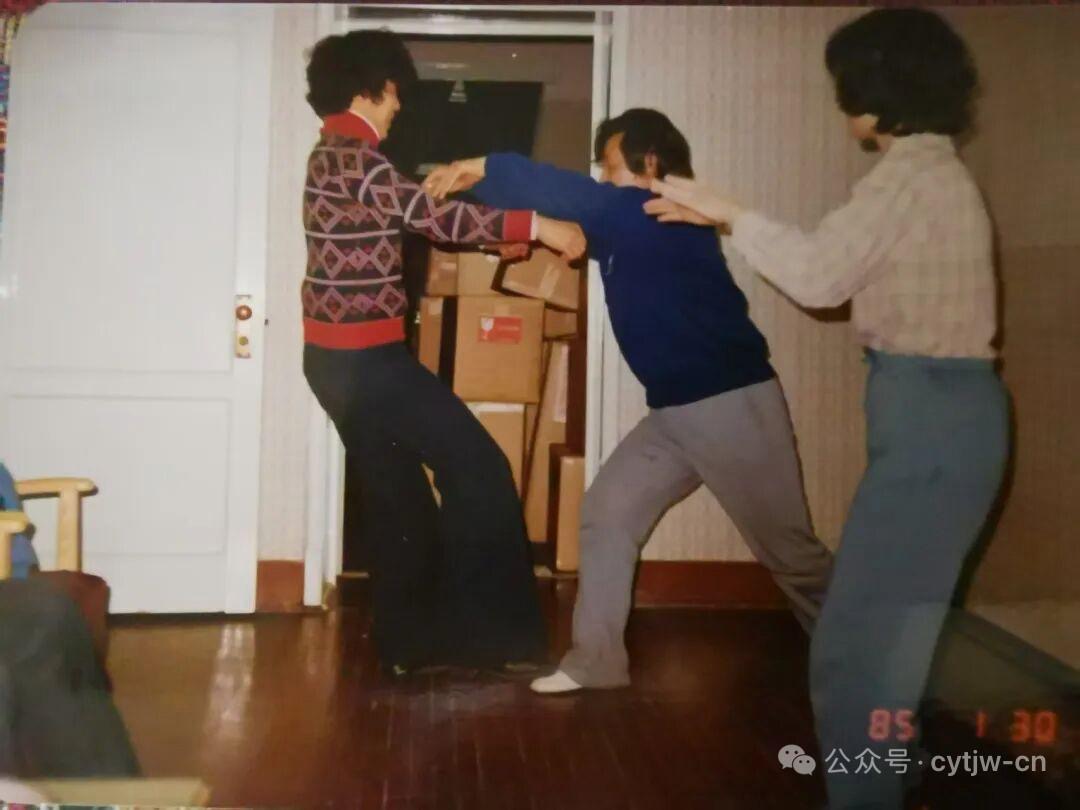
When we had time, we also went to the more open grounds of Taoranting Park to practice the complete form and our weapon methods. Sometimes, after training, the three of us went to Duyichu for shaomai dumplings. Li Gang and Chen Yu were close in age and shared similar interests. They got along well. Those days of wholehearted enthusiasm for martial practice were full of laughter, and even now the memories fill me with warmth.
The circle of transmission grows
It was also during this period that two Japanese Taijiquan enthusiasts, Eriko Sato and Suzuki, came to Beijing to study after hearing of Chen Yu’s reputation. He went to the Friendship Hotel each week to teach them, and the family-transmitted art of Chen Clan Taijiquan gradually began to spread.
Later, through an introduction from Teacher Zhang Maozhen, a disciple of Chen Zhaokui, Hou Zhiyang of Beijing Sport University sought out Chen Yu to study, specializing in the Chen Clan single saber (单刀 dāndāo). To help him improve, Chen Yu often made special trips to the university to instruct him and refine his techniques. Years of meticulous work and diligent practice brought Hou Zhiyang to a high level of skill. He later won first place in the single-saber event at a national martial arts competition.
Through Hou Zhiyang, I subsequently learned of Chen Peiju, who was also studying at Beijing Sport University. She addressed Chen Yu as “Uncle.” Through these connections of family and martial practice, my understanding of the Chen family’s martial genealogy, teacher–student relationships, and lines of transmission became increasingly detailed.
During my many years by Chen Yu’s side, he often told me stories about the Chen family, earlier generations of masters, and fellow practitioners in the lineage. Over time, my understanding of the genealogy, origins, and essential principles of Chen Clan Taijiquan grew clearer and deeper. Chen Yu has, without question, been the guiding light on my Taijiquan path.
Looking back over four decades
Looking back over half a lifetime, I feel that these connections through the martial art were somehow meant to be.
In 1976, sharing a courtyard with Tian Xiuchen brought me into contact with him and gave me my first glimpse of Taijiquan, planting the seeds of what was to come.
In 1986, I was fortunate to find my way to Chen Yu and formally begin studying the family-transmitted Gongfu Frame, setting out on the path of authentic martial practice.
Decades have passed. To this day, I continue to follow and assist Chen Yu, working together to promote the authentic family-transmitted Gongfu Frame and carry forward Taijiquan’s cultural tradition. Looking back over four decades on the martial path, from my first encounter with Taijiquan to my deep involvement in its transmission, every step has grown from these connections, and every step has remained true to my original aspiration.
Back to the chapter menuEpisode Four
Listening to Chen Yu Recall the Hardships and Trials of His Youth
20.08.2026
Original publication: Chen Yu Taiji · Issue 1226
From 1986 to early 1989, life was quiet and settled. Every day, Chen Yu rode his bicycle to work at Tiantanghe Chemical Factory as usual. However busy work became, he never missed his evening practice. Day after day, the routine continued.
In 1988, I was assigned a teaching position at a kindergarten run by the Education Commission. With a regular job to attend to, I could only go to Chen Yu for lessons on my days off and in my spare time. During those ordinary days of spending time together and learning from him, he often talked about the past. Little by little, he told me about the poverty, difficulties, and hard practice of his childhood. I came to understand that his solid, authentic family-transmitted skill had been built through the hardships of those early years, painstakingly, bit by bit.
Taking responsibility as a child
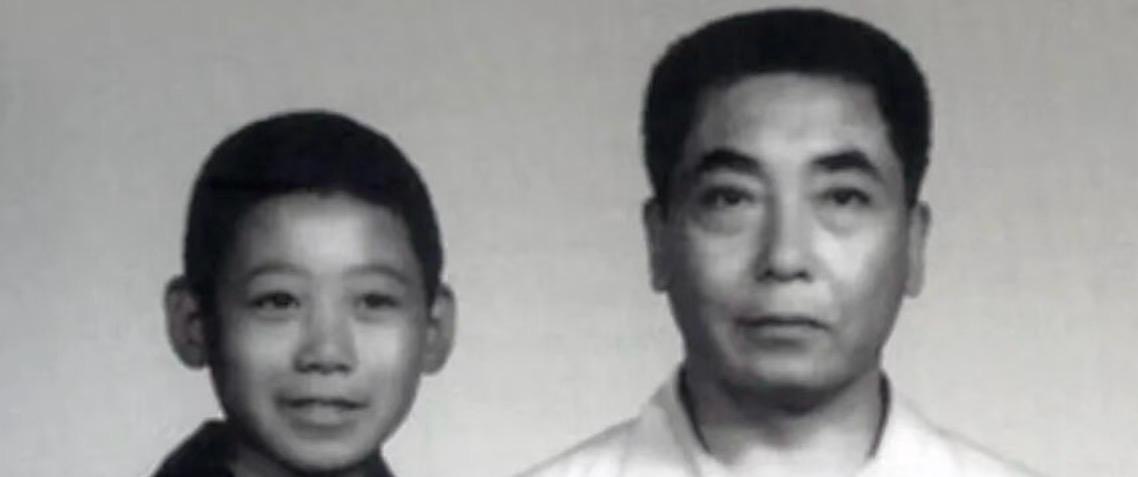
In 1972, his grandmother, Chen Fake’s wife, died. Chen Yu was only ten. From then on, he and his father, Chen Zhaokui, depended on one another. With his grandmother no longer there to manage the household, he took on responsibilities at an early age. He knew how hard his father worked, traveling to teach Taijiquan and earn a living, so he took the initiative to learn to wash clothes, cook, and care for his father’s daily needs.
Conditions were basic in those days, and there was no washing machine. In the bitter cold of winter, he had to wash the clothes in icy water, rubbing them again and again with his small hands. These early demands of daily life helped shape the capacity for hard work and endurance that stayed with him throughout his life.
A demanding teacher and father
He had begun formal Taijiquan training with his father at seven. Chen Zhaokui was especially strict with him. If even a small detail of the form was not right, or his force was the slightest bit misdirected, his father would criticize him sternly and correct him patiently. He was still a young child and often felt unfairly treated. Twice, he ran away from home in anger. But a child had nowhere to go. After wandering outside until late at night, he could only return home in silence.
At that age, he did not understand his father’s intentions; he only felt that his father was too strict. Many years later, he understood the depth of hope behind those weighty words: “You are my son, so you must endure hardships others cannot.”
The days spent alone
Also in 1972, his father frequently traveled far from home to teach and earn a living. On one such trip, he had no choice but to leave ten-year-old Chen Yu alone at home. Before leaving, he entrusted three yuan to a neighbor, asking the neighbor to give it to him in small amounts each day and reminding him to spend it carefully.
But he was still a child and did not know how to manage money. Sometimes he would buy an ice pop as a treat and soon find that the day’s allowance was gone. He often ended up penniless, without even enough to buy a meal.
Those days alone were lonely and difficult. Neighbors felt sorry for him and occasionally gave him something to eat. Sometimes, when he was hungry and had no food, he climbed onto the roof to pick jujubes. He would sit there alone, watching smoke rise from the kitchens below as families gathered around their dinner tables. Everyone seemed to have someone, while he was all alone. He quietly gritted his teeth and endured countless lonely days and nights.
When his father later learned how difficult things had been for him at home, he was deeply distressed. From then on, whenever he traveled to teach, he took Chen Yu along if he could. Chen Yu was still in elementary school and had to take time off at short notice to accompany him. With all the traveling back and forth, his schooling became intermittent, and his education suffered considerably. While others spent their childhood years steadily attending school, his were spent traveling, moving from place to place, and enduring hardship.
Developing the root
By the time he was sixteen or seventeen, whenever he returned to Chenjiagou, he went to practice beside the village well. To develop courage, steady his mind, improve his balance, and build a firm foundation in his lower body, he deliberately practiced Golden Rooster Stands on One Leg (金鸡独立 jīnjī dúlì) at the edge of the well.
The deep well lay right beside him. With danger at his feet, it was a severe test of concentration, composure, and stability. He had to remain completely focused, keep his body centered and upright, and stand firmly rooted. Any unsteadiness in his lower body or slight shift of his center of gravity could cause him to lose his footing and fall into the water. There was no room for carelessness.
Training conditions were extremely poor; progress depended on enduring the difficulties and continuing to practice. In winter, ice covered the ground around the well, making it cold, slippery, and difficult even to stand. After summer rain, the ground became muddy and slick, making a secure footing harder still. Every standing exercise and every repetition of Golden Rooster Stands on One Leg required him to focus his mind, settle his qi, maintain an upright posture, and root through his feet. This laid a deep foundation for the solid, authentic skill he would later develop.
Chen Yu often says that the basis of Taijiquan practice lies not in elaborate techniques, but in developing the root. Genuine Taijiquan skill requires taking root as the foot meets the ground. Once the foot is placed, empty and full are established and the foundation is stable. The foot must not shift arbitrarily, nor should it twist back and forth without substance or wobble about.
He calls these unnecessary twisting and wavering movements of the feet “twisting a drill”—拧钻子 nǐng zuànzi. He says that if the feet twist aimlessly, the Taijiquan has no root, the frame floats, and the force cannot sink. He often uses a simple comparison: the body is like the trunk of a great tree, and the limbs are its branches. However the branches sway from side to side, the trunk must remain settled, firm, and motionless. This is the true essence of the family-transmitted Gongfu Frame: a stable root, a correct frame, a settled body, and sinking force.
What hardship left behind
The poverty and loneliness of his youth, together with his own hard practice, established a lower body as steady as rock. They also shaped the resilience and composure of a martial artist, unshaken by either honor or humiliation.
The hardships and trials of his youth never broke him. Instead, they gradually became part of him, transformed into mature, authentic, substantial Taijiquan skill. Childhood poverty, disrupted schooling, and the hardships of training—experiences others would see only as adversity—ultimately became the foundations of his achievement. The hardships of life tempered his resolve; the hardships of practice strengthened his foundation; and the passing years refined his character and bearing.
It was this difficult youth, with hardships few could bear or sustain, that ultimately shaped Chen Yu’s family-transmitted Gongfu Frame of Chen Clan Taijiquan: firmly rooted and correctly structured, centered and deeply settled, simple and pure. It also enabled this authentic Chen family tradition to remain firmly rooted, passed from generation to generation, continually renewed.
Back to the chapter menuEpisode Five · Part One
A Turning Point in Life: 1989
26.08.2026
Original publication: Chen Yu Taiji · Issue 1230
In Beijing in 1989, few things were more precious than a permanent job. It meant a monthly salary, grain ration coupons, the prospect of housing allocated by one’s work unit, and the security of a lifetime’s employment. Losing it was almost like having to start life all over again. That year, a turning point quietly arrived that would completely change the steady, uneventful course of Chen Yu’s life.
Taijiquan enthusiasts in Zhumadian, Henan, had warmly invited him to come and teach. His work unit did not approve the extended leave, but he was deeply committed to the Chen family art passed down through generations. Unwilling to disappoint the practitioners who had sought him out, he set aside his concerns about worldly security and went to Zhumadian as promised. He stayed for more than a month.
When he returned to Beijing, a notice awaited him: his work unit was treating the matter as grounds for dismissal. In those days, being dismissed could leave a lifelong blemish on one’s personnel record, affecting opportunities at every turn. With no other way out, Chen Yu reluctantly resigned from the permanent job he had worked so hard to obtain.
A path his father had also taken
Fate sometimes follows remarkably similar paths. Years earlier, his father, Chen Zhaokui, had faced exactly the same predicament.
Chen Zhaokui had been invited to Shanghai to teach. His authentic family-transmitted skill was greatly appreciated by the local practitioners, who repeatedly urged him to stay and continue teaching. The Shanghai Sports Palace also offered to help arrange an extension of his leave with his employer, the Fifth Construction Company. But transportation and communication were limited in those days, and correspondence was slow. His leave was substantially exceeded, and his work unit likewise moved to handle the matter as dismissal. With no way out, he too had no choice but to resign.
Father and son, two generations of the family tradition separated by the years, found themselves on the same difficult martial path. Perhaps this is the destiny of those who carry a tradition forward.
Once someone resolves to shoulder the responsibility of preserving a family’s cultural inheritance, choices must be made, and the security of ordinary life must be set aside. In life, something must be given up for something else to be gained. To safeguard the authentic transmission of the family art, one must relinquish worldly ease. After resigning, Chen Yu immediately fell back into circumstances as difficult as those he had faced six years earlier.
Life after the factory
No salary, no grain ration coupons, no work unit to turn to: almost overnight, he had next to nothing. He was a grown man who had to earn a living and get through each day, yet his pockets were often empty. Those were days of extreme poverty. A three-yuan bowl of noodles was his food for the entire day. He ate half in the morning and half at noon. At night, there was nothing to do but endure the long hours on an empty stomach. Sometimes he ate; sometimes he went hungry. That was the reality of those years.
To survive, he went from place to place taking all kinds of temporary jobs. Yet however tired he was from the day’s work, however difficult life became, the first thing he did when he returned to his room each evening was practice Taijiquan.
Years of solitary practice
Life tested him in countless ways, but it never shook his determination to preserve the family’s Taijiquan. Through every turn and upheaval, he continued to pour all his heart and effort into the form that accompanied him day after day. He entered a long, lonely period of intensive practice behind closed doors.
He deliberately reduced unnecessary social contact, declined engagements, put distractions aside, and settled down to refine the family-transmitted Gongfu Frame, day after day, year after year. He did not allow himself a single day of neglect.
Many people can persevere for a short time. Gritting one’s teeth and holding on for days or months is not so difficult.
But to remain steadfast in poverty for years, with no money, no certainty of food or clothing, and no clear path ahead, while continuing to practice without interruption—that kind of composure, resilience, and wholehearted devotion to the martial path is rare.
As an old saying puts it, “To fulfill a great ambition, one must first put the body through hardship.”
It was precisely this difficult period that tempered his body, steadied his mind, and refined his art, laying the foundation for the responsibility of carrying the tradition forward.
Both father and son advanced through such trials. Only by cutting off the retreat to worldly security could the true heart of the martial path be revealed; only by giving up an easy life could mastery be attained. When life drives a person to the limit and strips away all outward adornment, the art can truly become part of their flesh and bones, and carrying the tradition forward becomes the destiny of a lifetime.
To be continued.
Continuation: practice under load
Continued from the previous installment.
Throughout those years of arduous practice, Chen Yu trained extremely hard and held himself to exacting standards. Besides his daily practice with thirty-jin dumbbells—about fifteen kilograms—he sometimes practiced the form with me on his back. I weighed nearly eighty jin, or forty kilograms.
At the time, he strapped five-kilogram sandbags to his arms and legs and wore a sand-filled weighted vest. With those loads already in place, he would carry me on his back and practice the form. He had to keep the frame low while producing an upward supporting force, holding my weight securely without allowing his posture to collapse. His back also had to maintain 掤劲 péng jìn, or peng force, supporting me so that I would not slip off. At the same time, his feet had to root downward and stabilize his lower body.
Within the same body, there was both an upward supporting force and a steady force sinking and rooting downward. Peng force filled his whole body. By the time he had worked through the complete form, his body was connected from joint to joint, every part fully supported by peng force. Every measure of his strength was repeatedly refined, reshaped, and developed through hardship.
What is true transmission?
Later, I often found myself thinking: what is true transmission? It is not a name in a genealogy, a photograph on a wall, or a title on someone’s lips.
True transmission is the determination to continue when the job is gone, the way back is closed, and there is no money left—to live on three-yuan noodles and still practice the form on an empty stomach.
True transmission is the resolve to bear an eighty-jin load without the frame falling apart, the body methods becoming disordered, or the force leaking away.
True transmission is the destiny embraced without regret by two generations of the Chen family, who weathered half a lifetime of storms and resolutely chose the same difficult martial path.
The turning point of 1989
In 1989, Chen Yu lost his secure job, his comfortable routine, and the protection of ordinary working life. Yet it was also the year he shed his restlessness and distractions, took root in poverty, and deepened his understanding through hardship. He lost the security the world valued, but gained refinement in his art and maturity of character. He truly took up the Taijiquan lineage passed down through generations of the Chen family.
Such is the way of great undertakings. Every transmission worthy of enduring through the ages begins with the willingness to give something up without hesitation; every achievement that moves the heart is forged through countless trials.

Translation and source notes
About this English version
This translation follows the supplied Chinese text in US English. It preserves the narrator’s personal assessments and rhetorical language. The opening summary, chapter navigation, subsection headings, and visual layout are editorial additions. The translation was done with the help of AI, Chat GPT and Kimi.
Training chronology
Episode Two places the beginning of formal sword instruction in winter 1986. Episode Three describes a visit with Chen Yu to Chen Yuxia in May 1986. Both dates have been retained.
Dumbbell and sandbag weights
Episode Two describes a pair or set of dumbbells weighing more than thirty kilograms. Episode Five’s continuation refers to thirty jin, approximately fifteen kilograms. One modern mainland Chinese jin is 0.5 kg. The narrator’s eighty jin is approximately forty kilograms. The sandbags in the continuation are explicitly five kilograms, not five jin; the weight of the vest is not stated.
Terminology and historical recollections
“Chen Clan Taijiquan” is used consistently. “Family-transmitted Gongfu Frame” identifies the tradition discussed in the series; “form” or “frame” is used according to context for the movements or their organization. “Basic physical strength” in Episode Two is kept distinct from the technical discussion of trained force. The Chinese spelling of peng force in Episode Five has been standardized to 掤劲 péng jìn. A li, used for the commute in Episode Two, is approximately half a kilometer in modern mainland usage.
Historical practice
The training passages are historical recollections, not recommendations for readers to imitate.
Source presentation
The supplied heading for Episode Five identifies it as Part One, Issue 1230, dated August 26, 2026. The continuation is included in full, without assigning a separate issue number or date. The related-article reference at the end of Episode One is preserved; originally published on Weixin. Photographs were supplied for this article. The original source uses simplified Chinese characters.