Chen Wangting: The Early History of Chen Taijiquan
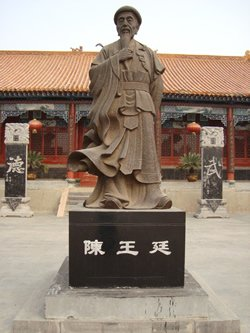
Chen Wangting 陈王廷, also known as Chen Zouting 陈奏庭, is traditionally regarded as the central early figure in the development of Chen Taijiquan. He lived through one of the most turbulent periods in Chinese history: the collapse of the Ming dynasty and the establishment of Qing rule in the seventeenth century.
Later Chen family tradition remembers him as a soldier, militia leader, scholar and martial artist who eventually withdrew to his home village of Chenjiagou in Henan. There, according to the family records, he taught his descendants, worked the land and developed boxing methods that became the basis of the later Chen family martial tradition.
The broad outline is compelling. The historical details, however, are considerably more difficult to reconstruct. As with much early Chinese martial arts history, family records, later biographies and oral traditions overlap with legend.
What Do We Actually Know About Chen Wangting?
Information about Chen Wangting's life is surprisingly fragmentary. One of the central family sources is the genealogy preserved in Chenjiagou, the 陈氏宗谱 Chénshì zōngpǔ.
Such genealogies primarily document descent and family relationships, but they may also contain brief biographical notes about individual ancestors.
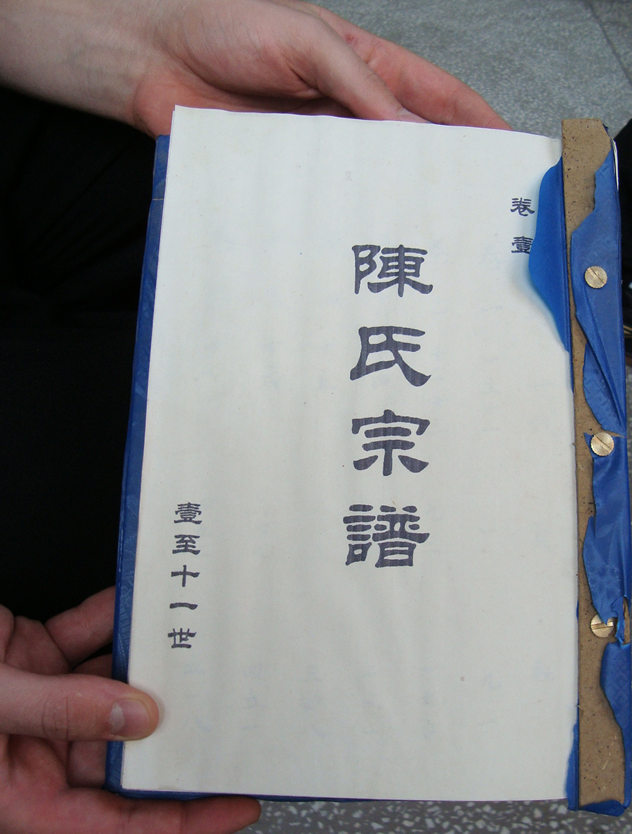
The genealogy records Chen Wangting as having three sons and gives Zouting 奏庭 as another name. A biographical note identifies him as a military licentiate toward the end of the Ming dynasty and a civil licentiate during the early Qing period. It describes him as a renowned martial artist in Shandong, credits him with defeating bandits reportedly numbering more than one thousand, and calls him the originator of the Chen family's boxing and weapon methods.
A fuller narrative appears in the section “Biographies of Chen Family Taiji Boxing Masters” 陈氏太极拳家列传 Chénshì Tàijíquánjiā lièzhuàn of Chen Ziming's 1932 book 《陳氏世傳太極拳術》 Chénshì shìchuán Tàijíquánshù. This account relates stories about Chen Wangting's association with Li Jiyu, the arrival of Jiang Fa and the traditional identification of the two men in a surviving portrait.
Chen Ziming's biography appears to preserve earlier material circulating within the Chen family, probably including records and traditions associated with Chen Xin. Some of it may ultimately derive from the family genealogy, but the precise chain of transmission is not always explicit. The fuller narrative should therefore not be treated as a verbatim quotation from the zōngpǔ.
Tang Hao's postscript to Chen Ziming's book provides additional information about the provenance of the genealogical material. Tang reports that he and Chen Ziming travelled to Chenjiagou to investigate the history of Taijiquan and that Chen Huaisan, also known as Chen Sen, preserved the copy of the Chen family genealogy they consulted. Tang states that the note beside Chen Wangting's name was originally written in 1754 and supplemented in 1822.
Later family narratives describe Chen Wangting as withdrawing from public affairs during the transition from the Ming to the Qing dynasty and devoting his later years to farming, martial practice and teaching his descendants. His surviving poem 《長短句》 Chángduǎnjù presents a similar image of an aging former warrior who had turned away from official ambition.
An important perspective on the historical sources comes from Gu Liuxin. In his account of Taijiquan’s origins, he cites the Annals of Huaiqing Prefecture, the Annals of Wen County, and the Annals of Anping County as evidence for Chen Wangting’s military activities before the fall of the Ming dynasty. According to Gu, these records describe Chen as a leader of local defence forces in Wen County and connect him with operations under the county magistrate Wu Conghui. On this basis, he reports that research in the 1960s placed Chen’s development of his boxing around the 1660s, rather than around the Ming–Qing transition in 1644 (Gu Liuxin, 1996, p. 3).
Chen Wangting's Military Background
Chen Wangting was probably born around the beginning of the seventeenth century in Chenjiagou, Wen County, Henan. The precise year remains uncertain.
The family genealogy calls him a 武庠生 wǔ xiángshēng, a term connected with the Ming military examination system. This suggests that his martial training belonged not simply to a village fighting tradition, but to the broader military culture of his time.
Such candidates were expected to possess practical martial skills, especially riding and archery, while also having some command of military and classical literature. This context is important because the martial arts of the late Ming period were closely connected with military training, weapons practice, militia organization and written strategic manuals.
Chen Wangting is also associated in later accounts with militia activity in Wen County during the increasingly chaotic final years of Ming rule. Local rebellions, armed groups, famine, political collapse and military conflict shaped much of northern China during this period.
It is therefore quite plausible that Chen Wangting's martial background was considerably more practical and militarized than later romantic images of Taijiquan might suggest.
The Fall of the Ming and the Retreat to Chenjiagou
The Ming dynasty collapsed in 1644. For people who had served or supported the old order, the dynastic transition was not simply a political change. It could mean the destruction of careers, loyalties and entire social networks.
Chen Wangting appears to have belonged to this generation of people whose lives were fundamentally altered by the collapse of the Ming.
Family tradition describes him withdrawing from public life after recognizing that the dynasty's fate had been decided. He returned to Chenjiagou, where he farmed, studied and instructed younger members of the family.
This image is particularly vivid in a poem traditionally attributed to him. In it, the elderly Chen Wangting looks back at years spent wearing armor and fighting, only to conclude that rank, recognition and worldly success ultimately meant very little.
Chen Wangting: Verses of Reminiscence
《長短句》 Chángduǎnjù
歎當年,披堅執銳,掃蕩羣氛,幾次顚險!蒙恩賜,枉徒然。到而今,年老殘喘,只落得《黃庭》一卷隨身伴。悶來時造拳,忙來時耕田,趁餘閒,敎下些弟子兒孫,成龍成虎任方便。欠官糧早完,要私債即還,驕諂勿用,忍讓為先。人人道我憨,人人道我顚。常洗耳,不彈冠。笑殺那萬戶諸侯,兢兢業業,不如俺心中常舒泰,名利總不貪。參透機關,識彼邯鄲,陶情於魚水,盤桓乎山川,興也無干,廢也無干。若得個世境安康,恬淡如常,不忮不求,哪管他世態炎涼,成也無關,敗也無關。不是神仙,誰是神仙?
With a sigh, I recall the years when I was armored and armed, sweeping away countless enemies and often in great danger myself. Receiving favor and honors, being deceived—all in vain.
Today, old and close to my last breath, I have nothing but a scroll of the Yellow Court, 黄庭 Huángtíng, to accompany me.
When melancholy, I create boxing forms; when busy, I tend the fields. In leisure, I teach my pupils, children, and grandchildren, allowing them to become dragons and tigers as they wish.
The grain taxes are paid early and my own debts settled promptly. Proud posturing and idle talk are useless; harmony and accommodation come first.
Everyone calls me simple; everyone calls me mad. I often listen without intervening.
I laugh at the countless households and vassals toiling diligently and conscientiously. Their state is unlike mine, for my heart is usually relaxed and peaceful, and I do not crave fame or wealth.
I understand all the workings and see through things, content to fish by the water. I pause among mountains and rivers. Agitation is no concern of mine, and loss does not affect me.
If I reach the limit of my life in health, then I am generally calm and mild, free of envy and greed. I care neither for the hypocrisy of the world nor for success or defeat. If this is not an immortal, who is an immortal?
The surviving wording exists in slightly different textual versions, so it is better understood as a piece transmitted within the Chen family tradition than as a perfectly fixed literary text.
The line “When bored, I create boxing; when busy, I cultivate the fields” has naturally become one of the most frequently quoted passages in discussions of Chen Wangting. If the attribution is accepted, it gives us a remarkable glimpse of how the Chen family remembered his later life: not as a professional martial arts founder creating a new “style” in the modern sense, but as an aging former military man developing and teaching martial methods within his family.
Chen Wangting and Jiang Fa
One of the most famous figures connected with Chen Wangting is Jiang Fa 蒋发 Jiǎng Fā.
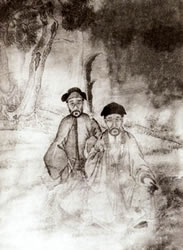
A biography published by Chen Ziming in the early twentieth century recounts that Jiang had previously served under the rebel leader Li Jiyu. He later became a servant of Chen Wangting.
In one story, Jiang chased a rabbit beside the Yellow River and caught it before it had run a hundred paces. Chen Wangting then remembered that Li Jiyu had once possessed an officer famous for his extraordinary running ability and realized that Jiang was supposedly the same man.
This same tradition identifies the standing figure in an old portrait of Chen Wangting as Jiang Fa.
The problem is that evidence for Jiang Fa is extremely thin. The stories are fascinating, but almost all of the detailed material about him appears in considerably later sources.
For that reason, Jiang Fa should probably be treated as an important figure in the traditional narrative of Chen Taijiquan, rather than as someone whose precise historical role can currently be reconstructed with confidence.
Li Jiyu and the World Around Chen Wangting
The connection with Li Jiyu is nevertheless historically interesting. Li Jiyu was a real rebel leader active around Dengfeng and the Song Mountains during the final years of the Ming. Later Chen family accounts describe him as an acquaintance of Chen Wangting and state that Chen tried unsuccessfully to persuade him to abandon his rebellion.
Whether every detail of the story is accurate is impossible to establish, but the broader setting is entirely plausible: Chen Wangting lived in a region in which local militia, rebels, military candidates, armed escorts, bandits and government troops constantly interacted.
This turbulent environment is probably a much more useful background for understanding the early Chen martial tradition than later images of isolated masters quietly practicing purely “internal” exercises.
Did Chen Wangting Create Taijiquan?
Within the Chen family tradition, Chen Wangting occupies the central position at the beginning of the art. Later sources credit him with creating or refining boxing routines that developed into Chen family Taijiquan.
But the word “created” needs some care.
This also helps explain why research into Chen Taijiquan repeatedly encounters earlier martial material.
Qi Jiguang and Late Ming Martial Arts
One particularly important comparison is with the military general Qi Jiguang 戚继光 Qī Jìguāng. His famous military writings include a chapter on unarmed boxing that collected techniques from several martial traditions of the sixteenth century.
Later Chen family boxing texts contain terminology and methods that overlap significantly with material found in Qi Jiguang's writings. Given Chen Wangting's likely education within the late Ming military environment, it is entirely plausible that he knew this type of material.
This does not mean that Chen Taijiquan was simply copied from Qi Jiguang. Rather, it suggests that the early Chen system developed within a broader martial culture whose methods were already circulating in military manuals, local traditions and family practice.
The Tang Village and Li Family Theory
Another origin theory emerged from documents found in Tang Village in Henan. Li family genealogical material has been interpreted as suggesting that members of the Li family and Chen Wangting practiced or developed exercises together, including methods using terms such as Taiji and Wuji.
The story is interesting, particularly because the families were geographically close and traditions of shared temples, kinship and exchange between villages were entirely possible.
At the same time, parts of the narrative appear strikingly similar to later martial arts foundation stories, and claims of extremely long and uninterrupted transmission should be treated with caution.
At the present stage, the Tang Village material is therefore best understood as an interesting contribution to the debate rather than a final solution to the origins of Taijiquan.
A Brief Timeline of Chen Wangting
-
Around 1600:
Chen Wangting is probably born in Chenjiagou, Wen County, Henan. -
Late Ming period:
Family records describe him as a military student. Later accounts associate him with armed service, militia organization and activity in Shandong and Henan. -
1640s:
Northern China is marked by rebellion, famine, banditry and dynastic collapse. Traditions connect Chen Wangting with Li Jiyu and local militia activity. -
1644:
The Ming dynasty collapses. -
Early Qing period:
Chen Wangting apparently withdraws to Chenjiagou. Family tradition describes him farming, studying and teaching younger members of the Chen family. -
Later seventeenth century:
He is traditionally credited with developing boxing methods that became foundational to the later Chen family martial tradition.
Two Texts Attributed to Chen Wangting
Two written works are traditionally associated with Chen Wangting. Neither should be treated casually as an autograph manuscript written and preserved directly by him, but both are important parts of the Chen family's historical transmission.
1. 《长短句》 Chángduǎnjù — Chen Wangting: Verses of Reminiscence
The first is the autobiographical poem discussed above. It presents Chen Wangting as an aging veteran reflecting on military service, political disappointment, farming, boxing and the teaching of his descendants.
Whether every line can be proven to originate directly from Chen Wangting is difficult to establish. Nevertheless, its preservation within Chen family materials makes it an important source for understanding how later generations remembered him.
2. 《拳经总歌》 Quánjīng Zǒnggē — The Summarizing Song of the Boxing Canon
The second text is entirely different in character. The 拳经总歌 Quánjīng Zǒnggē is a compact martial poem traditionally attributed to Chen Wangting. Rather than discussing philosophy or meditation, it describes tactical actions: striking, pressing, hooking, evading, enticing, throwing, sweeping, elbowing, kicking and deceiving the opponent.
拳经总歌 Quánjīng Zǒnggē
纵放屈伸人莫知,诸靠缠绕我皆依。
劈打推压得进步,搬搁横采也难敌。
钩掤逼沉人人晓,闪惊取巧有谁知。
佯输诈走谁云败,引诱回冲致胜归。
滚拴搭扫灵微妙,横直劈砍奇更奇。
截进遮拦穿心肘,迎风接步红炮捶。
二换扫压挂面脚,左右边簪庄跟腿。
截前压後无缝锁,声东击西要熟识。
上笼下提君须记,进攻退闪莫迟迟。
藏头盖面天下有,惯心剁胁世间稀。
教师不识此中理,难将武艺论高低。
English Translation
Release lengthwise, bend and extend—others do not know this.
I always follow wrapping and winding, 缠绕 chánrào.
Split, strike, push, and press, advancing forward.
Move, cast aside, attack horizontally, and pull downward—these are difficult to counter.
Everyone knows hooking, warding off, surging forward, and securing,
but who knows evading, startling, skillfulness, and luring?
Feign defeat and use deceptive steps—who says I have already lost?
Entice the opponent into a trap, then charge forward again to regain victory.
Roll over, knot, connect, and sweep with dexterity and subtlety.
Split and chop horizontally or straight—unusual and more wondrous still.
Intercept, enter, cover, and block, then pierce the heart with the elbow.
Step into the wind and strike with the Red Cannon Fist.
Change twice, sweep, press, hang, and kick to the front;
thread left and right and make the legs firm as pillars.
Interrupt in front or press behind, seamlessly closed.
Make noise in the east but strike in the west—this must be well understood.
Gather above and lift below—the ruler must remember this.
Attack forward, withdraw, and evade; never be late.
Hide the head and cover the face—these are seen throughout the world.
But piercing the heart and cutting the flanks are rare on earth.
If a teacher does not understand this logic,
how can the heights and depths of martial skill be assessed?
The terminology of the poem is sometimes difficult to translate precisely, particularly where individual expressions may refer to named techniques or methods whose meaning depended on the martial practice of the time. Different surviving versions also contain several variant characters. What is unmistakable, however, is the overall character of the text: it describes a highly practical martial system based on entering, striking, throwing, controlling, evasion, deception and continuous adaptation to an opponent.
Whatever the precise textual history of the poem, its character is worth emphasizing. The martial tradition attributed to Chen Wangting is not described as passive, mystical or concerned only with health. It is an art of entering, striking, throwing, controlling, deceiving and responding continuously to an opponent.
Chen Wangting and the Beginning of Chen Clan Taijiquan
Much about Chen Wangting remains uncertain. We do not possess a diary describing exactly which routines he practiced, which teachers he studied with or precisely how the early Chen boxing system was assembled.
What we do have is a combination of family genealogy, later Chen family writings, regional history and technical evidence.
Taken together, these sources make Chen Wangting the most important early historical reference point for the martial tradition that eventually became known as Chen Clan Taijiquan.
It is more interesting to see him as a highly trained martial practitioner living at the end of the Ming dynasty, drawing on the military and martial knowledge of his time, and transmitting a system within the Chen family that later generations continued to develop.
That picture may be less spectacular than a single moment in which Taijiquan was suddenly “invented”, but historically it is much more convincing — and, in my view, much more interesting.
Sources and further reading
Bissell, G. (1993). Research on the early history of Chen Taijiquan.
Chen Xin. 陈鑫. Family historical material reproduced in later editions of his writings on Chen family Taijiquan.
Chen Ziming. 陈子明. The Art of Taiji Boxing According to the Chen Family, 1932.
Chen family genealogy, 陈氏家谱 Chénshì Jiāpǔ.
Des Forges, R. (2003). Research on Henan society and rebellion during the Ming-Qing transition.
Gu Liuxin. 顾留馨. (1984). Research on the history of Taijiquan.
Gu Liuxin (1996). “The Origin, Evolution and Development of Shadow Boxing.” In Chen Style Taijiquan, 2nd edition. Beijing: Morning Glory Publishers, especially pp. 2–3. ISBN 7505404806.
Hucker, C. O. Studies of Ming and Qing official titles and administrative institutions.
Qi Jiguang. 戚继光. Jixiao Xinshu 纪效新书 Jìxiào Xīnshū.
Ranné, N. (2011). Die Wiege des Taijiquan: Der soziokulturelle Kontext der chinesischen Kampfkunsttheorie mitsamt einer Analyse der ältesten Bewegungsformen des Taijiquan. Berlin: Logos Verlag. ISBN 978-3-8325-2477-7. Available on Amazon.
Shahar, M. (2008). The Shaolin Monastery: History, Religion, and the Chinese Martial Arts.
Wells, M. (2005). Research concerning early Henan martial traditions and the Chen family.
For Chen Ziming's account of Chen Wangting and Jiang Fa, see the English translation at Brennan Translation.