
A lifelong practice
At our last Taiji camp, a student asked me what my personal training looks like. Since my practice has changed considerably over time—I began training in the 1990s—I always find this question difficult to answer in a way that also helps students with their own practice. A few days after the camp, I arrived at the following thoughts.
1Learning the art
When we begin a practice such as Taijiquan, there is usually a great deal of learning to do alongside the physical practice. Learning includes movements, patterns and drills, as well as the names of movements, fundamental concepts and the theory we need in order to practice well.
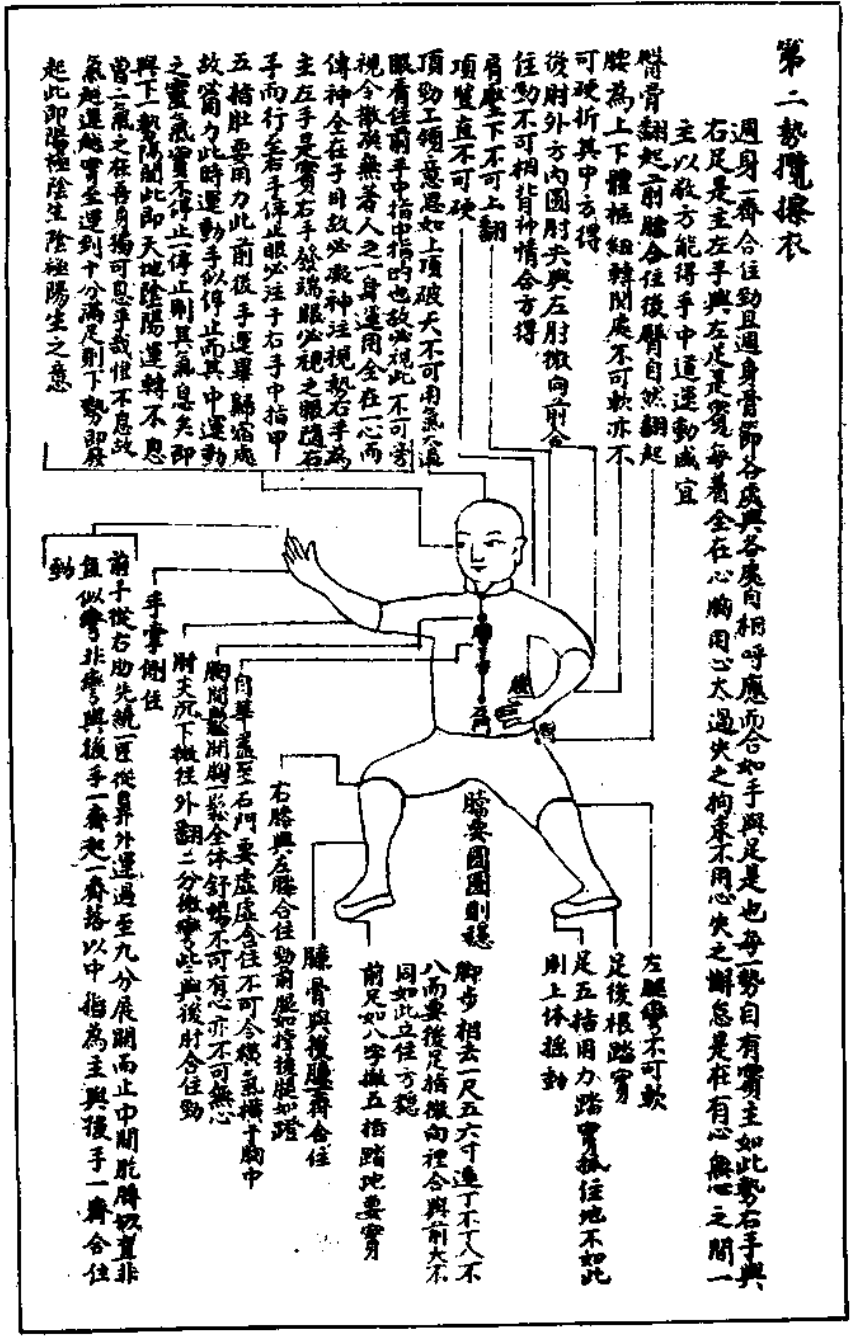
The illustration by Chen Xin, for example, describes the requirements of a particular posture. Understanding such material is part of learning the framework of the art.
After a while, the learning aspect may recede somewhat, allowing training to become our main focus. Training then means repeatedly drilling movements and movement patterns while applying the specific concepts we have learned.
2Training and adaptation
After more time, our focus may shift again. When we train, we intend to drill something and often adhere more closely to external requirements. Our teacher might place us in a deep stance and realign our arms and legs to help us understand the “three external connections,” for example.
During this phase, we adapt ourselves to the practice so that we can gradually make it our own. There may be a great deal of training—with sweat and burning muscles—as the body adapts to a new structure, new alignment and new methods of generating force.
3Cultivating the practice
Once the practice has truly become our own, however, we can begin to cultivate it. In cultivation, the practice increasingly adapts to our needs because its principles have already become internalized.
We may use it to cultivate our health, our mental practice, our rehabilitation, our fitness or perhaps our spirituality.
Training The practice changes us.
Cultivation We change the practice.
Of course, all three aspects are interwoven, and our focus can move back and forth between them. Learning Taijiquan is not a linear process. It is better understood as a learning spiral in which we repeatedly revisit familiar material, deepen it and integrate it more fully.
I mean this in a very precise and concrete way. Lifting yourself upward, for example, will feel and function quite differently in the beginning than it does in later practice. It is the same—and at the same time something entirely different.
In my personal experience, however, a gradual change does take place over the years. When we begin something entirely new, there is more learning to do. Later, training becomes more prominent as we adapt to a new body structure, new alignment and new methods of generating force. Later still, internalization and cultivation allow us to make the art our own so that it can support us throughout our lives in many different ways.
The following graph is an oversimplification, but it may help illustrate what I mean:

Although we can continue learning, training and cultivating throughout our lives, these remain slightly different aspects of practice—and they should be.
I sometimes see this distinction reflected in students. Someone may come to Taijiquan looking for a cultivation practice from the very beginning. This can be difficult because they have not yet completed enough learning and training: there is simply not much to cultivate yet.
Another person may be fascinated by new knowledge and the sometimes strangely “arcane” concepts of Taijiquan. Once they have understood these ideas intellectually, they may prefer to search for still more knowledge rather than putting in the necessary training. The training aspect is then weakened, and genuine progress and skill may never develop.
If we want to make Taijiquan a lifelong practice, learning, training and cultivation are all essential. Each asks for a different kind of motivation, but none of them can fully replace the others.